Saturday, October 31, 2009

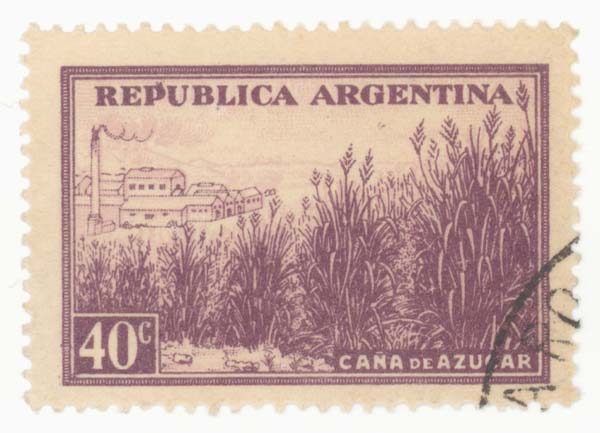
A small selection of the 40c1L6

These stamps were used in 1956 and 1957 and show some generalized plate wear.


The two major shades of the 40c2C

The first shade is purple.


The second shade is reddish purple.


Here is a detail of these two shades compared.

A few 40cNGR plate varieties

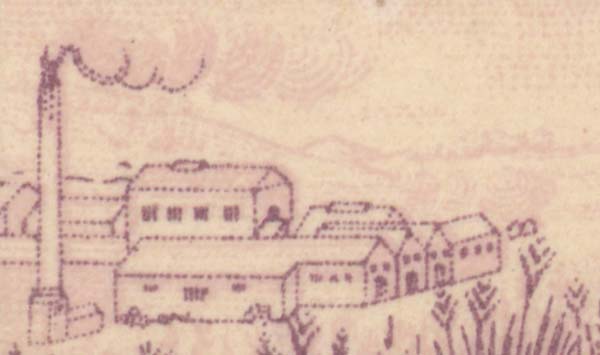
These plate flaws need to be confirmed as plate varieties.


These two stamps show a plate variety I have shown previously.


A selection of 40cNGR

This stamp was printed in at least two shades of purples. This first specimen is reddish purple.


Here is a dated 40cNGR.


This comparison shows a range of shades for this stamp.

The two clay 40c printings

The first printing, from 1943, is on the second clay paper, the CL1B. The RA is vertical. The paper is of medium thickness and poorly perforated.


The second printing is on lighter colors and from 1952. The paper is thinner, the CL2B. The RA is horizontal.


Here is a comparison. The top two stamps are CL1B, and the bottom two are CL2B.

Selection of 40c1E2

This first specimen has bright colors.


These two specimens are a lighter shade.


These 40c1E2s have been postmarked in March and April of 1938.


Early 40c (1E1 and 1E3a)

These early printings show almost no plate wear.


This stamp has some plate wear around "REPUB" of "REPUBLICA."


Here is a clearly printed stamp dated 1940.


Here are two specimens from a dirty and slightly worn out plate.


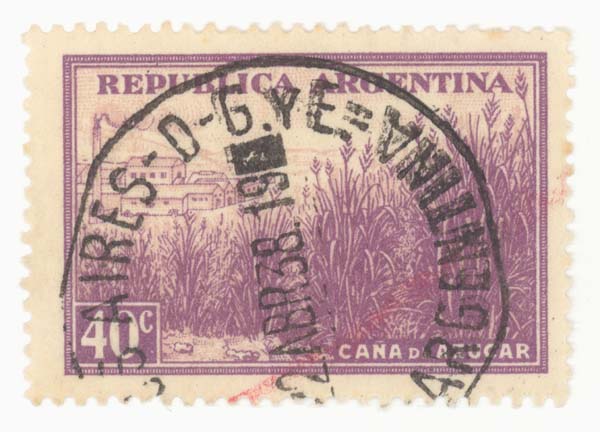
A few 40c early postmarks

This first specimen is 1E1.


This stamp has a plate flaw likely from when the plate was assembled.


Saturday, October 17, 2009

Two 20 pesos blocks

The appeal of these high value blocks is unmistakable. Such a high face value was most likely paid for a post office box receipt.

This block is a 20p1E4.


This block is a 20pNGR.


The upper right stamp has a small indentation below the '20.'

The 1p2D

The 1 peso value, like the 20c Large Format Cattle stamp (the 20cLC) was printed on the diffused (2D) and clear (2C) straight rays papers. This block was printed on the 2D paper.


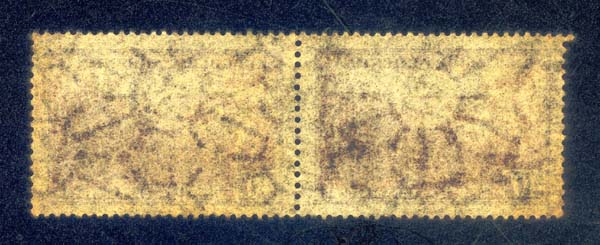
Here is the back showing the watermark.


The lower right stamp has a plate scratch probably caused by placing the die into the printing cylinder.

The 1L2 watermark

These two examples are 5 pesos stamps.


A 5p1L2 block showing repeated plate varieties

With this block we can postulate that the plate was made up in pair of rows and that some plate varieties come from the master dies. This pattern is found on other stamps of this series (the 10c Rivadavia Red and the 50c, for example).


The right side stamp in the first row has the same scratch...


.. as the right side stamp in the third row


The left side stamp in the second row is a common plate variety.


Various 5p1L2 plate varieties

The lower left stamp in this block is the 'long scratch across palm plate variety.'


This plate has two plate varieties.


Here is a detail of the upper left stamp.


Here is a detail of the upper right stamp.

Plate variety candidate for the 5p1L2

The lower right stamp in this block has an indentation to the trunk of the palm.


Here is a detail. I do not find a second specimen in my sample.

The most elusive 5p plate variety

The upper right stamp in this block has a scratch in the background that is very difficult to find.


The give-away is this outer edge break.


Here is a detail of the scratch.


In this comparison, I have blocked out the area around the scratch.

A selection of 5pNOPs

The first specimen may be a plate variety, but I do not find a second specimen in my sample.


Additional 5pNOPs


including one canceled in 1950.

Monday, October 12, 2009

Some plate varieties of the 20cSC

A 20cSC1L1 stamp showing a long drawn line on the plate.


Two 20cSCCL2A-D's.


Three 20cSCCL2A-L's.


The 20cSC1L5z

This is the clearliest, highest quality printing of the 20cSC.

Some specimens show poor centering.


Here is a range of typical shades.


Here is a very rare light shade.


A slightly over-inked printing.

The 20cSC1L1

These stamps are typically average to poor printings.


A dirty printing.

The 20cSCCL2A-D Dark Blue Clay

Here is a range of shades of typical specimens.


A clean printing, uncommon for this stamp.


Smudged printings.


A worn printing.

The 20cSCCL2A-L Light Blue Clay

Here is a range of shades of typical specimens.


A slightly darker shade.


A dirty printing.


A worn printing.

Small threads in two late papers for the 20cSC

Rein noticed small threads in the clay (CL2A) and regular (1L1) papers. I find these as well, and in several colors.

A 1L1 example:


a clay dark blue example,


and a second clay dark blue example.


A small selection of used postcards


Late usage of the 2 pesos and 5 pesos

These are the two latest uses I have.

2 pesos canceled December (16?) of 1956.


and 5 pesos canceled February 28 of 1957.


A postal entire with Census information

This postal entire found limited use. It has information about Argentina from 1934.


The stamp is Type II.


Here are details of the back of this entire, a fold-out.


Rates within Argentina from Ravignani

Based on the book by Miguel Emilio Ravignani about Argentinean postal rates from 1877 to 1974, which luckily includes the complete period of postal use for the Argentina 1935-51 issue these are the rates within Agentina for the three most commonly used rates.

The three main postal rates for mail within Argentina are the simple letter rate (20 grams or approximately 1/2 ounce), the certified mail rate, and the express mail rate.

The simple letter rate for each 20 grams is 10 centavos before 1937, and 5 centavos from 1937 to 1948. The certified and express rates before 1944 are not clear from this book. Here are the rates from 1944 onwards in the format (simple letter rate, certified mail rate, express mail rate):

1944 ( 5 centavos, 25 centavos, 25 centavos )
1949 ( 10 centavos, 30 centavos, 40 centavos )
1951 ( 20 centavos, 60 centavos, 1 peso )
1952 ( 20 centavos, 1.30 pesos, 1.50 pesos )
1956 ( 40 centavos, 2 pesos, 2 pesos )