Sunday, July 26, 2009

Comparisons of the 15cMG-SO 'TINA'

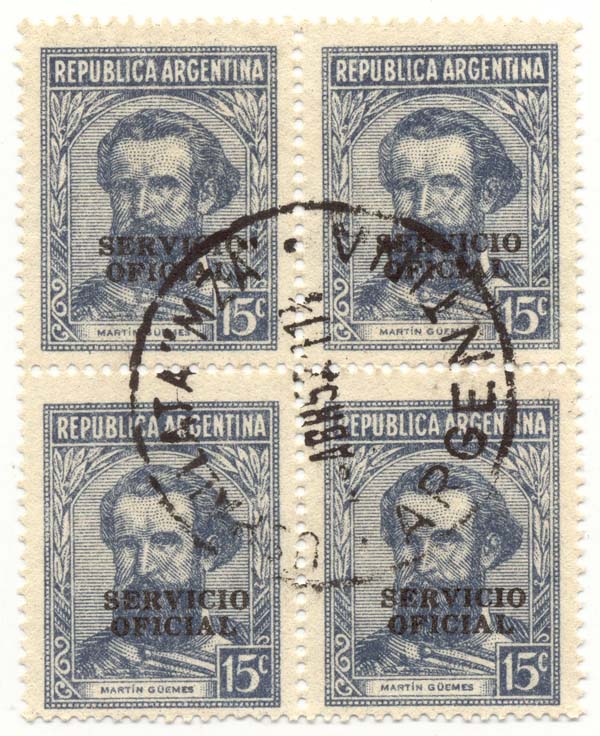
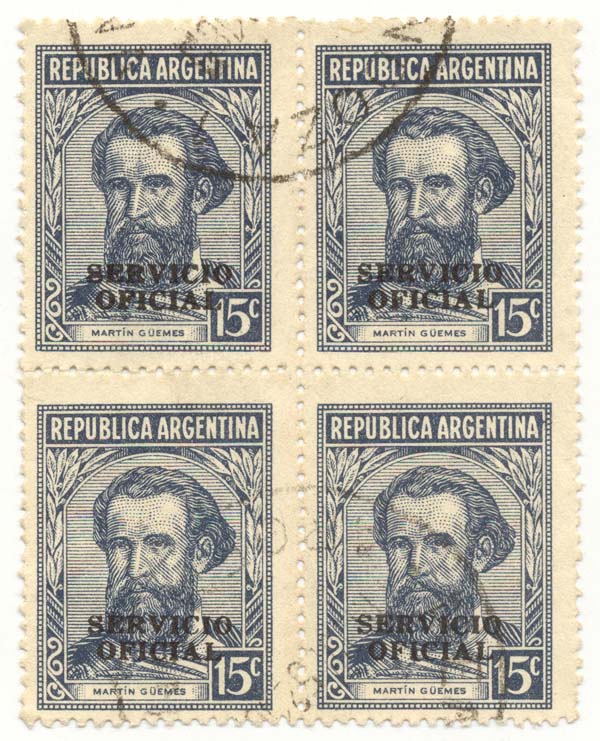
These comparisons show several types of overprints for the 'TINA' plate variety. The slight differences between the placements of the overprint are an indication that this variety is found more than once on the plate.


15c Martin Guemes 2C 'Fat I in TINA of ARGENTINA'

Here is a selection of 15cMG2C-SO blocks with the 'Tina' plate variety.

Upper Left 'Tina'


Upper Right 'Tina'


Lower Left 'Tina'


Lower Right 'Tina'

15c Martin Guemes 1L 'Fat I in TINA of ARGENTINA'

This variety, by how commonly I find it, is most likely a master die plate variety. I always find the 'Tina' plate variety with a stamp to the right with a small gap on the inner line next to the last A of ARGENTINA. Except for what seems to be an early printing, represented by the first block I show here, I also find a similar 'gap' plate flaw on the stamp below the 'TINA' stamp.

'Tina' Plate Variety Upper Left


Upper Left stamp


Upper Right stamp


Lower Left stamp


'Tina' Plate Variety Upper Right


Upper Right stamp


Lower Right stamp

15c Martin Guemes 'break under first A of ARGENTINA'

These two blocks have this plate variety. By its scarcity I postulate that it is not common on the plate, although when I compare the overprints from each block and the additional flaws on the second block, I find that these are two separate plate positions.

Here is a detail of this flaw:


The upper left stamp in the following block is the plate variety.


The upper right stamp in the following block is the plate variety.


Here are the comparisons of the plate flaws and the relative distance between the overprints.


Focusing on the L of OFICIAL in the overprint we can see that these are different types of the overprint for the same flaw and same positions relative to the flaw.

Saturday, July 18, 2009

10c Rivadavia Red Types II and III in two blocks

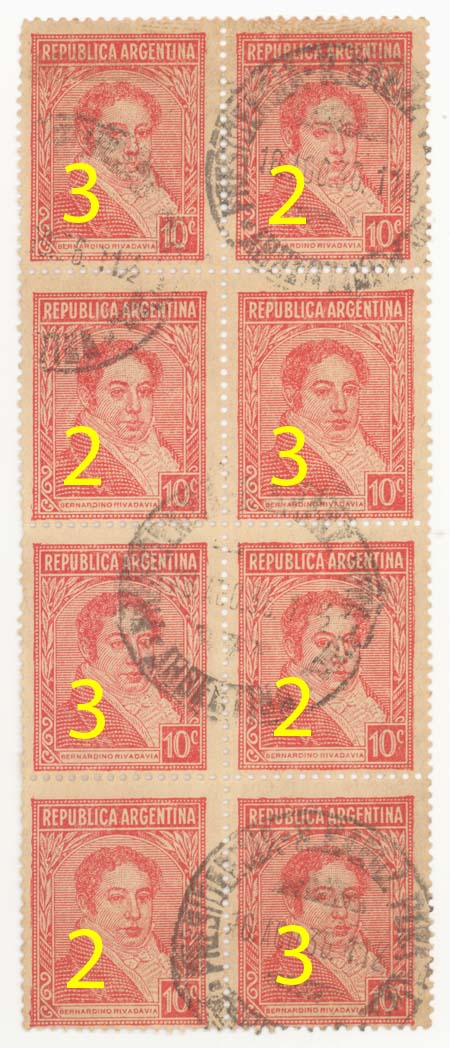
Here are two blocks labeled for types (2 is II, 3 is III). I do not find any plate flaws that connect these two blocks.


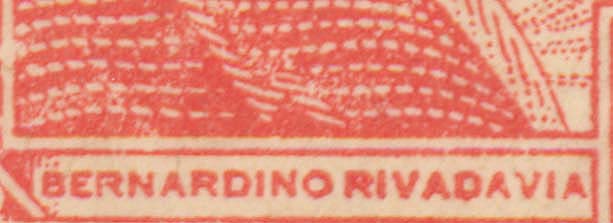
'two dots' 10c Rivadavia Red Type III plate variety

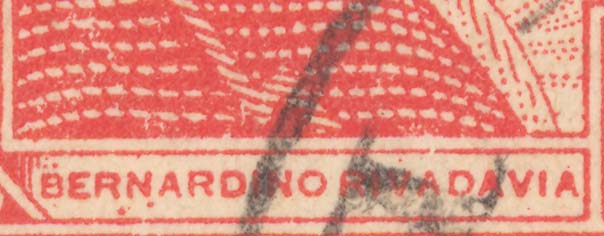
The two dots are found under the letters RN of BERN in BERNARDINO.


I find two specimens with this plate variety, recently reported by Rein. The two I find are different positions in the plate, as are the two from the position immeditely right of this plate variety. Here are comparisons of the 'two dots' specimens;
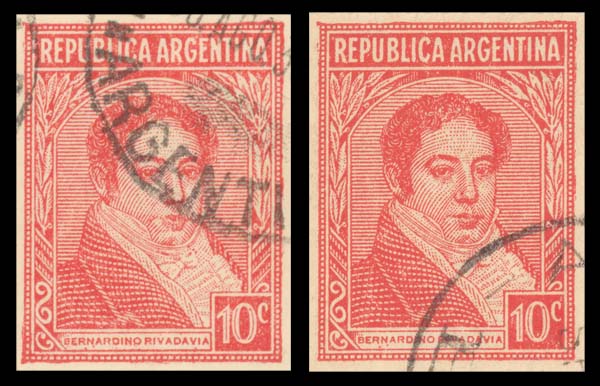


and of the position to the right of the two examples on hand:


Here is the strip of three with the first example.


Left-most stamp
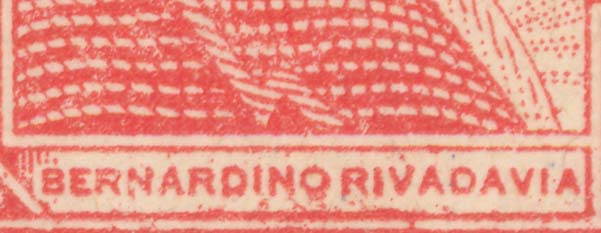


Middle stamp, 'two dots' (shown at top)

Right-most stamp


top detail of the right-most stamp


bottom detail of the right-most stamp


The second specimen is found top left in this block.


Top left, 'two dots' plate variety


Block labeled for types (2 is II, 3 is III):

Relative numbers of the three types of 10c Rivadavia Red

I have selected a group of clean used stamps to look for types. I chose multiples of three or more as a first step to figure out where the Type III's are on the plate.

I found the blocks listed in this table from a selection of approximately 5,000 stamps. Because this stamp was used mostly as a single and sometimes as a pair, multiples are relatively uncommon.

The relative rarity of the Type I I already knew about. I would use a larger sample, including singles, to measure it with higher accuracy, but 1 in 20 of Type I compared to the sum of Types II and III seems realistic.


From these blocks an 82.5 percent / 17.5 percent split between Types II and III results. From the stamps with selvages I have, I only find type IIIs for the selvage with the vertical field of lines.

Comparison of the 10c Rivadavia Red Type II and Type III

I am in the process of absorbing a significant discovery that Rein has just made: there are additional types of the 10c Rivadavia Red and Brown stamps! This is a most interesting development.

For the typographed stamps with the selvage with a field of vertical lines I find two types. Because we already have a type I and a type II for the red Rivadavia, I am calling it type III. From looking at a small sample, I do not find any multiples with both types, and if this continues to be the case, then each of type II and type III are from separate compositions.

Type II


Type III


Comparison of Type II and Type III

There may be several master die varieties of Type III. All type II seem to share the two dots under the B of BERNARDINO, and all type III seem to share the dot in the lapel .


I find both types used in 1936.

Picasa Album of 10c Rivadavia Red Type II and Type III

The Type III has a dot in Rivadavia's lapel next to the right-side denomination box that the Type II does not. Both types are from the typographed printing with field of lines selvage.

Monday, July 13, 2009

10pNGR-SO Blocks with plate varieties

Here are three blocks of four with plate varieties. This plate has so many plate varieties that the rarities are the dies without them.


Lower Left


Lower Right


Upper Left


Upper Right, three triangular dots in field


Lower Right


Upper Right, three triangular dots in field


Lower Right


10pNGR Blocks with plate varieties

Here are three blocks of four with plate varieties. This plate has so many plate varieties that the rarities are the dies without them.


Upper Left


Lower Left


Upper Left, three triangular dots in field, which seems to be a master die plate variety.


Upper Right


Upper Left


Upper Right, three triangular dots in field


Lower Right

Sunday, July 12, 2009

Summary of the first round of this study

The fourteen publications that form the first round of this study consist of a 2007 book, 10 books of notes from 2008, a 2009 book on the 1E1 and 1E2, and two books of notes from the first half of 2009.

The advancements Rein has made and I am in the process of learning from are not in this first round. I am still absorbing the watermark work Rein has done, which I think is incredibly useful and advanced. The same is true for the printed overprints and lately the check dots Rein keeps finding in various plates.

All I wanted to do in these notes is have a 'first round' study available to everyone in a quick reference. There are many, many holes in the first round material, most notable:

1. A deeper look at watermarks following Rein's seminal work.
2. Showing a complete run of the Departmentals, and especially a reasonably complete run of these stamps on cover.
3. Wrapping up the 'Servicio Oficial' issues by including Rein's work and the work of Luis (in the Argentinean Forum).
4. A close look at many plate varieties (the master die varieties as well as the 'single position' varieties).
5. A close look at the magnificent postal history of this issue.

Saturday, July 11, 2009

2009 Notes on the papers and 'Servicio Oficial'


2009 Notes, Publication No.2: The papers, contributions to June 2009. (PDF, 11.6 MB)

Table of Contents: Status of this study 29, Papers to-do list 30, Measurement of the 1E1 grid 31, easurement of the 1E3 grid 33, A miss-perfed block of the 25c1E3 36, 1E3s after help from Rein 40, The 2p1E3b 45, The 2p1E3b 'cream' frame 47, Measurement of the 1E4 grid 49, Conjecture about all 5c1E4t being from booklets 53, 50c dated specimen back scans 55, The 14 types of the 50c 61, The 1E papers for the high values 68, The 1E3 papers for the high values 72, There are two types of NGR 75, Reference NOP Specimen 76, Comparison of the 1E4 and 2D papers 77, A back scan of the 2D paper 79, 2C and 2D examples showing the watermark 80, Horizontal and Vertical 2P2s 83, Straight Rays 2C paper 91, Reference scans of the 1L papers 94, Close-ups of 1Ls 102, Comparison of the 1L2 and 1L4 papers 105, The 2p1L6 Watermark 108


2009 Notes, Publication No.3: The 'Servicio Oficial' printings from a study undertaken March 2009. (PDF, 11.5 MB)

Table of Contents: 1E1 'Servicio Oficial' 29, 1E2 'Servicio Oficial' 31, The NGR 5c Moreno 'Servicio Oficial' 36, The 2D 5c 'Servicio Oficial' 39, The 1E4 5c Moreno 'Servicio Oficial' 42, The 5c1E1t-SO and the 5c1E3-SO 47, The 15c 1E3/1E4 Small Format Cattle 'Servicio Oficial' 52, The 2D/2C 15c Guemes 'Servicio Oficial' 58, The Wavy Rays 15c Guemes 'Servicio Oficial' 63, NGR and NOP 'cents' 'Servicio Oficial' 66, The 'cents' 1E3 and 1E4 'Servicio Oficial' 69, The 20c Small Format Cattle 'Servicio Oficial' 76, The clay printing of the 25c 'Servicio Oficial' 79, Less common issues of the 25c 'Servicio Oficial' 82, Vanishing sun on the 25c 'Servicio Oficial' 88, The 1E4 printings of the 25c 'Servicio Oficial' 92, The 1E3 printings of the 25c 'Servicio Oficial' 94, Watermark curiosities on the 25c 'Servicio Oficial' 101, Impossible dates on the 25c 'Servicio Oficial' 102, The 1E1 issue of the 25c 'Servicio Oficial' 103, Later issues of the 50c 'Servicio Oficial' 108, Several master die plate varieties of the 50c 115, The 1E issues of the 50c 'Servicio Oficial' 120, The 40c 'Servicio Oficial' 125, Later papers of the 1P-SO 126, Early papers of the 1P1Ex-SO 131, Two candidate plate varieties of the 2P1L-SO 135, Major plate varieties of the 2P1L-SO 137, A remarkable 2P1L-SO plate variety 139, Two types of the 2P1L-SO 141, Two minor plate varieties of the 2PNGR-SO 146, A variable plate variety on the 5 pesos 'Servicio Oficial' 148, Two 5 pesos 'Servicio Oficial' plate varieties 150, 'Servicio Oficial' High Values 153

PDF book on the 1E1 and 1E2 issues

This book includes the Departmental Officials (and I am still missing a few of these) and the 'Servicio Oficial' issues.


2009 Book: 1E1 and 1E2 paper issues, including the Departmental Officials and 'Servicio Oficial.' (PDF, 21.6 MB)

Table of Contents:

The 1E1 ‘cents’ issues of October 1, 1935 39, Perforations of this printing 40, The two die types of 10c Rivadavia Red stamps 43, San Martin combined use 48, A selection of mint and used blocks 51, The 1E1 issues of January 1, 1936 56, The 15c1E1-D 56, The 25c1E1 58, The 30c1E1 and 40c1E1 61, The 50c1E1 64, The 1pL1E1 67, The 2p1E1 78, The 5p1E1 80, The 10p1E1 81, The 20p1E1 83, The 1E1 20cMG and 1 peso with map boundaries 83, The typographed 1c and 5c 1E1s of 1937 86, The 1E2 issues of 1936/1937 88, The Departmental Officials 93, The 1E1 cents 95, The 1E1 issues of early 1936 104, The 5c typographed, 20cMG and 1 peso without map boundaries DEPOFs 112, The 1E2 25c and 30c printings 120, The ‘Servicio Oficial’ 1E1 and 1E2 issues 122, The 1E1 Small Format Issues 122, The 1E2 Large Format issues 128

Thursday, July 9, 2009

10c Rivadavia Red heights compared

I find that the type I stamp is slightly longer than the type II stamp. In these images the type I stamp is the first stamp from left to right.


Here are the three types of selvage:

1. Type I with six horizontal lines.
2. Type II with solid horizontal bar.
3. Type II with field of vertical lines.


I have also checked the 'Servicio Oficial' and found it to be Type II.

10c Rivadavia Red Type II Plate Variety

I find these two specimens, one with lower selvage.


Sunday, July 5, 2009

Picasa album of 25c1E1/2/4 range of use

25c1E4 range of use

This stamp saw use during 1940. This first specimen may be a postmark error since all 1E4s I have come across for all denominations date from 1940.


Picasa album of 25c1E3a range of use

25c1E3a range of use

This stamp saw first use early in 1939. This stamp is identical to the 1E1 except for the color and translucency of the paper. The back of the stamp has a symmetrical rectangular grid.


25c1E1/2 range of use

The 25c1E1 was issued January 1, 1936 and is uncommon.


The 1E2 was in use during 1937. This early use specimen dates from late 1936.


10c Rivadavia Red Type II Inking 'eye' varieties

I do not find any of these curiosities to be repetitive.


10c Rivadavia Red Type II Plate Variety No. 2

Unlike many plate curiosities that are not repetitive, this variety is.


10c Rivadavia Red Type II Plate Variety No. 1

Unlike many plate curiosities that are not repetitive, this variety is.


10c Rivadavia Red Type II Plate Curiosities

I only find single specimens for these.


10c Rivadavia Red Type I Plate Curiosities

I only find single specimens for these two.


10c Rivadavia Red Type II

The second type is considerably more common than Type I. It is found in the dark red of the Type I.


This stamp is found in a wide range of shades and print quality.


10c Rivadavia Red Type I

This stamp was printed in a small run and on a single color.


Here is a specimen with a worn out printing.

Saturday, July 4, 2009

Buenos Aires non-standard postmarks part 2

I do not know the meaning of the letters appended to Buenos Aires in these postmarks. The V.A. that is added to E.R.V. to come up with E.R.V.V.A. 2 could mean VIA AEREA.

E.R.V. 1o and 2o :: E


VIA AEREA :: E


E.R.V.V.A.2 :: E


Buenos Aires non-standard postmarks part 1

Except for A.P., I do not know the meaning of the letters appended to Buenos Aires in these postmarks.

A.P. (Agencia Postal)


(E) V 1o and 2o


V.3 :: E.O.


3-V :: D-G. y E.


V.5 :: R

High value PERFINs

Here are ACO 5 pesos specimens,


...and several 10 pesos with PERFIN A.M

Thursday, July 2, 2009

Brigada and Ambulante explained

Based on information from aficionado, a member of the Filatelia Argentina forum, the Brigada postmarks are the first type for the roaming (Ambulante) service for mail from Buenos Aires to the interior of the country. I previouly did not know what the Brigada postmarks were for, or that they are an early type of Ambulante postmark.

Here is a Brigada 18 example.


Here is an Ambulante No. 92.

Buenos Aires special use postmarks

Here are several Buenos Aires specimens for specific types of mailings.

BUENOS AIRES E I


BUENOS AIRES E R V (I can't make out the last letter)


BUENOS AIRES E R V V A 2


BUENOS AIRES E V 2


BUENOS AIRES E F I-12